How did we get here?
From the Age of Reason to the corporate takeover of American democracy

"Next!" illustrated by Udo Keppler for Puck magazine 1904, depicts Standard Oil as an octopus gripping the Capital and reaching for the White House.
Facts are stubborn things;
and whatever may be our wishes, our inclinations, or the dictates of our passion,
they cannot alter the state of facts and evidence.
John Adams
The Scientific Revolution with its methodology of following evidence to logical conclusions, led to social, political, and judicial reform during the Age of Reason. This era ignited the American Revolution and inspired the framing of the U.S. Constitution. Democracy has walked hand in hand with science since the founding of America. As Thomas Jefferson wrote, “Freedom, the first-born of science.” But today, science is under severe attack. An attack on science is an attack on facts and critical thinking. It is important to ask why. As historian Timothy Snyder wrote in On Tyranny, “Believe in truth. To abandon facts is to abandon freedom. If nothing is true, then no one can criticize power, because there is no basis upon which to do so. If nothing is true, then all is spectacle. The biggest wallet pays for the most blinding lights.”
Let us not shy away from hard truths,
for it is through honest conversation that change is born.
Ida Tarbell, author of The History of the Standard Oil Company, 1904
The fight against climate change and the struggle to defend democracy are interconnected. Disinformation campaigns, led by and for private interests, have led to climate inaction and the destabilization of American democracy. It is the common link. The wrench in the works. If we want to maintain democracy and protect our planet we must face uncomfortable truths. The corporate takeover of American democracy began with the rise of the modern conservative think tank. This corporate influence set out to push the Republican Party to the far right and laid the groundwork for a neoliberal Democratic establishment.
Decades ago, environmental legislation bridged party lines. In 1962, the publication of Rachel Carson’s book Silent Spring exposed the dangers of pesticides like DDT and launched the modern environmental movement. During Thanksgiving weekend in 1966, deadly smog caused over 200 deaths in New York City. By 1969, disasters like the Santa Barbara oil spill and the Cuyahoga River fire fueled overwhelming bipartisan support for environmental reform and inspired the founding of Earth Day on April 22, 1970. This momentum resulted in the Clean Air Act and the establishment of both the National Oceanic and Atmospheric Administration (NOAA) and the Environmental Protection Agency (EPA) in 1970, followed by the Clean Water Act of 1972 and Endangered Species Act of 1973.
But Corporate America pushed back. In 1971, Lewis Powell Jr., a prominent corporate lawyer, wrote a confidential eight-page memo for the U.S. Chamber of Commerce titled, “Attack on American Free Enterprise System”. It urged big business to mobilize and blueprinted a long-range strategy on how to capture political power by aggressively influencing the media, academia, public policy, and the judiciary. Two months later, Nixon nominated Powell to the Supreme Court where he began cementing corporate personhood into law.
The Powell memo quickly became a galvanizing force. By 1973, the Heritage Foundation was founded, and a flood of ultraconservative and libertarian think tanks poured into Washington, DC. Corporate tax cuts, deregulation, union busting, privatization, and cuts to public spending became the bedrock of their neoliberal agenda. During Ronald Reagan’s presidency, big business gained unprecedented access to the Oval Office, and the Heritage Foundation’s 3,000-page Mandate for Leadership served as the administration’s policy guide. Continuing the deregulation trends of the Regan era, President Clinton followed suit and monopolies boomed.
Those seeking profits were they given total freedom,
would not be the ones to trust to keep government pure and our rights secure.
Indeed, it has always been those seeking wealth
who were the source of corruption in government.
Thomas Jefferson
Abraham Lincoln wrote, “Our government rests in public opinion. Whoever can change public opinion, can change the government.” And that is exactly what big business set out to do. Over the past 60 years, Big Oil libertarians, corporate leaders, and ultraconservative billionaires have funneled fortunes into establishing an interlocking network of think tanks, advocacy groups, PR firms, and legal organizations to shift public opinion, influence legislatures, and reshape the judiciary. Not for the public good, but for private interest; not for the whole, but for the few. Knowing their endgame would be widely unpopular, they adopted stealth strategies to disguise their anti-government pro-corporate agenda. They claim “Government is the problem!” because they want to rule unfettered. They preach “Individual freedom!”—spin it on its head—and use it as an excuse for their reckless disregard of the common good. And nothing illustrates this more than Big Oil’s willingness to set the world on fire for the sake of profit.
Government is instituted for the common good;
for the protection, safety, prosperity and happiness of the people;
and not for the profit, honor, or private interest of any one man, family, or class of men.
John Adams

Each day Humble supplies enough energy to melt 7 million tons of glacier
1962 Life Magazine ad for Humble Oil, known today as Exxon
The fossil fuel industry has known about climate change since the 1950s, but Big Oil prioritized profit over people and planet. When the scientific consensus on climate change threatened the bottom line of the energy sector, this infrastructure of political influence was deployed with devastating efficiency. In 1988, NASA scientist James Hansen made international headlines after testifying before Congress and alerting the public about global warming. This historic testimony was the catalyst that triggered Big Oil's massive public relations backlash. Heavily funded by the industry, conservative think tanks played a leading role in manufacturing doubt about climate change to confuse public opinion and thwart regulatory action.
A decade later, the 1997 Kyoto Protocol was the first international treaty to address climate change. To undermine these efforts, Big Oil again doubled down with disinformation. Between 1997 and 2018, Exxon invested $37 million and Koch Industries funneled over $145 million into 90 separate organizations manufacturing climate denial narratives. While publicly professing concern for jobs and the economy, the industry knew full well that climate change would ultimately lead to economic disaster. This deceptive campaign achieved its ultimate objective in 2001, when President George W. Bush officially rejected the Kyoto Protocol.
The fossil-fuel-based empire of Koch is the second largest private company in America and one of America’s biggest polluters. Since 1967, Charles Koch has led this conglomerate, viewing any federal agency that limits his profits as a corporate nemesis. Charles, along with his late brother David, became primary architects in developing this right-wing political influence machine. It’s a top down operation. Its endgame is always the same… corporate tax cuts, deregulation, privatization, and deep cuts to public spending. Where there is political chaos, you can bet that plutocrats like Koch are working behind the scenes directing the political theater. Grants from private foundations fund science skeptics to undermine scientific consensus. Campus research centers like the Mercatus Center legitimize and populate his anti-government pro-corporate ideology. Astroturfing campaigns give the illusion of a groundswell of public support. Podcasters dressed in suits are on the take. From climate action and workers’ rights to education and health reform; from local school boards to the Supreme Court; from Latinos to Millennials—their once-fringe ideologies have infiltrated every corner of mainstream American culture.
A popular Government, without popular information, or the means of acquiring it,
is but a Prologue to a Farce or a Tragedy; or, perhaps both.
Knowledge will forever govern ignorance:
And a people who mean to be their own Governors,
must arm themselves with the power which knowledge gives.
James Madison
Americans should know about this well-coordinated dark money network shaping American politics. Here’s a shortlist. Conservative think tanks like the Heritage Foundation, Heartland Institute, and Manhattan Institute craft narratives to drum up culture wars and influence policy. The Federalist Society and the Judicial Crisis Network prepare and advance corporate-friendly judges, while also filing lawsuits and amicus briefs to reshape federal law. ALEC (American Legislative Exchange Council) allows corporate lobbyists to secretly collaborate with Republican lawmakers to draft model legislation that benefits private interests and far-right agendas. And then there’s Americans For Prosperity (AFP), founded by the Koch Brothers in 2004 and widely considered to be the most powerful conservative advocacy group in America.
Ideas do not spread by themselves; they spread only through people.
Which means we need a movement.
Charles Koch, Libertarian Review, July 1978
In 2009, the Tea Party began as a decentralized group of frustrated citizens rallying against Wall Street bailouts and federal spending. AFP capitalized on the disorganized organic fury of the movement and built that energy into a political force to serve the policy goals of Koch. AFP provided massive organizational support, funding, buses, and activist training workshops to mobilize chapters against Cap-and-Trade and the Affordable Care Act. In 2008, AFP had only 8,000 members, but by 2010—at the height of the Tea Party movement—its membership had surged to 1.5 million. Charles Koch got the movement he was waiting for. By weaponizing this populist anger, the Koch network successfully transformed a protest against corporate bailouts into a lucrative victory for corporate deregulation.
In 2010, the landmark Citizens United ruling converged with the midterm elections and the decennial census. Republican strategists capitalized on the moment with a coordinated two-part plan dubbed “REDMAP” to flip statehouses and control redistricting. That same year, while riding on the Tea Party wave, AFP mobilized massive voter turnout and unleashed political attack ads against climate-conscious Republicans and vulnerable Democrats. In 2011, redistricting began using mapping technology with such precision that it transformed swing states into impenetrable crimson chambers. In 2012, despite Democrats winning 1.4 million more votes nationwide, Republicans secured a 33-seat majority. And as the newly elected Republicans filed into Congress, they signed AFP’s ‘No Climate Tax’ pledge, effectively rendering federal climate legislation dead in the water. Hundreds of conservative nonprofits make up this interconnected ecosystem. To give a sense of scale, Charles Koch controls roughly 32 of these groups, with combined assets exceeding $8 billion.
For decades, Charles Koch has been instrumental in pushing the Republican Party further and further to the right. Koch and his circle of around 450 likeminded mega-donors reward politicians willing to do their bidding and sabotage those who do not fall in line. Over the past 30 years, the oil and gas industry has pumped over 80 percent of its donations into the GOP coffers. This Big Oil influence is clearly reflected in how the party has blocked climate policy and green technology for decades.
Policy decisions on climate change
are being deliberated every day by those without full knowledge of the science,
and often with intentional misinformation spawned by special interests.
James Hansen, NASA scientist
Since the days of the Gilded Age (1865-1902), Big Oil has been both the driver of progress and a thorn in the side of democracy. Support for the administrative state, also known as the regulatory state, began during the Gilded Age with the rise of a new aristocracy whose economic tyranny was wreaking havoc on our republic. Captains of industry, like J.D. Rockefeller of Standard Oil, amassed vast fortunes amidst widespread political corruption, with no regard for nature, workers, consumers, or the ever-growing divide of wealth inequality. President Teddy Roosevelt reined in this unbridled threat to the public good and began the regulatory state to guard against corruption and lawless monopolies.
Our national life is on every side distinctly poorer, uglier, meaner,
for the kind of influence he exercises.
(Describing J.D. Rockefeller)
Ida Tarbell, author of The History of the Standard Oil Company, 1904
With Big Oil at the helm, the political influence machine has worked for decades to undermine public trust in government and the administrative state in order to dismantle it. The Trump administration’s agenda plays right into this corporate playbook and the manufacturing of doubt. Project 2025, the Heritage Foundation’s latest version of Mandate for Leadership, signals allegiance to its Big Oil financiers by ignoring climate science and maximizing the expansion of fossil fuels. But its top priority has always been to dismantle the administrative state. What was once working in the shadows is now an all-out ambush. Dismantling oversight agencies and firing government watchdogs that fight waste, fraud, and abuse is unleashing corruption. The mass firing of civil servants is paving the way to the privatization of our public goods, our public lands, and our social safety nets. The gutting of regulatory agencies that ensure industries are not violating regulations, is a robber baron’s dream come true and the beginning of a nightmare for those downstream. We are in the midst of an aggressive re-entrenchment of corporate power to enrich self-serving corporate elites that prioritize profits over the well-being of the American people. Add in the Trump tax cuts, and voila, it is a massive transfer of wealth into the hands of the few.
To sin by silence, when we should protest, makes cowards of men.
The human race has climbed on protest.
… The few who dare, must speak and speak again to right the wrongs of many.
excerpt from “Protest” by poet Ella Wheeler Wilcox, 1914
Sands shift. The response to the Gilded Age was the Progressive Era, a time rich in activism when the extraordinary efforts of ordinary people spoke truth to power and mobilized movements for positive change. Democracy is a work in progress. It is only as good as the efforts of its citizenry. Today, we are living through a dark chapter in American history. But as in life, challenges present opportunities. If there is anything that we can take away from this, it is that democracies thrive best when we actively participate in the democratic process. A momentum is building, and now is the time to imagine and realize a bold vision for the future. It is time to move beyond the selfish profit-driven free-market throw-away society mindset and renew a social contract that balances both our individual rights with the common good. This involves reforming our democracy to be responsive to We the People, while at the same time, protecting the planet for the generations of tomorrow.
There can be no effective control of corporations while their political activity remains.
To put an end to it will be neither a short nor an easy task, but it can be done.
Teddy Roosevelt, 1910
Campaign finance reform is the gateway on which everything else hinges. If we only focus on isolated economic symptoms—like grocery prices or the cost of gas—voters will remain trapped in an endless loop of bouncing back and forth between election to election. The rising cost of living and the ever-growing divide of wealth inequality is directly linked to corporate billionaires buying elections and taking over the reins of government. The skyrocketing cost of campaigns forces legislators to spend over half their time fundraising instead of making policy. Billionaires are bankrolling campaigns and flooding the airwaves with dark money attack ads to install politicians who will draft legislation that protects corporate profits over the public interest. This dynamic has opened the floodgates of corporate influence and drowned out the very real voices of the American people that government was designed to serve.
The way to remedy this is through campaign finance reform and publicly financed elections. Overturning Citizens United and ending partisan gerrymandering must happen alongside these changes in order to restore our democracy. The vast majority of Americans agree that corporate money needs to get out of politics. The time is now for Americans of all party affiliations to unite in solidarity against these powerful forces of corruption. After all, the preamble to the United States Constitution begins with We the People, not we the corporations.
The fight against climate change and the struggle to defend democracy are interconnected. How we respond to disinformation devised by and for private interests will determine whether we rise up to the ideals of democracy or collapse into tyranny. We all play a role in directing the future of our society. The question is, what kind of society do we want for our future.
THESE are the times that try men's souls.
…Tyranny, like hell, is not easily conquered; yet we have this consolation with us,
that the harder the conflict, the more glorious the triumph.
Thomas Paine, American Crisis, December 1776
Political Cartoons of the Gilded Age (1865-1902)
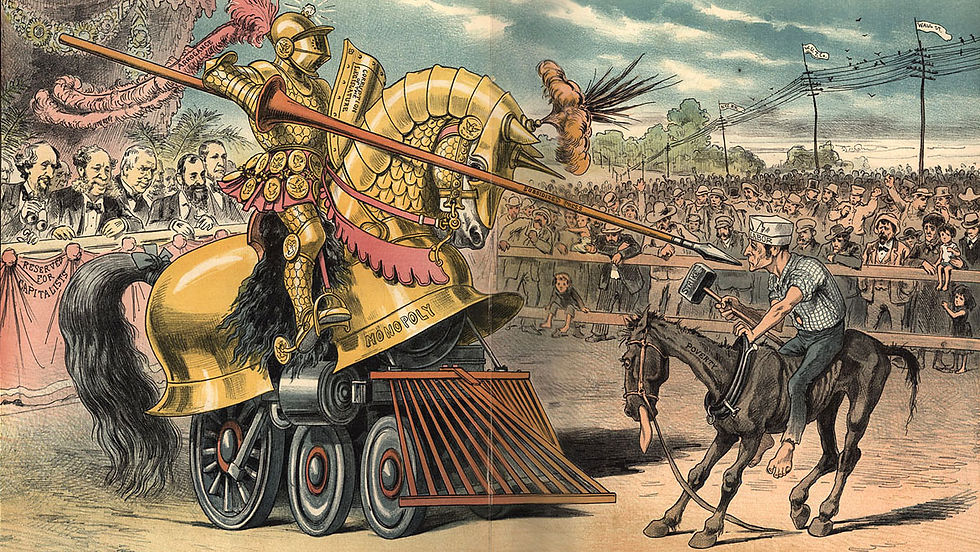
"The Tournament of Today - a set-to between labor and monopoly" by Frederich Graetz for Puck magazine, 1883.
To the left sits a group of robber barons behind a banner that reads "Reserved for Capitalists" and to the right stands a crowd of workers and barefooted children. The railroad knight is embellished with the words "Monopoly," "Corruption of the Legislature," "Subsidized Press," and "Arrogance" and jousts a laborer on a starving horse captioned with "Poverty," "Labor," and "Strike".
I asked a man in prison once how he happened to get there. He had stolen a pair of shoes.
I told him that if he had stolen a railroad he could be a United States Senator.
Mary Harris “Mother” Jones, 1903
For further information:
Jane Mayer, author of Dark Money • Christopher Leonard, author of Kochland • Senator Sheldon Whitehouse, author of The Scheme • Frontline documentary, "The Power of Big Oil," (2022) • Union of Concerned Scientists, "The Climate Deception Dossiers," (2015) • Supreme Court of the State of New York, In the Matter of Rudolph W. Giuliani, pages 30-33, (2021) • January 6th Committee Final Report, (2022) • Campaign Legal Center "Results of Lawsuits Regarding the 2020 Elections"
Online resources:

Comments